3 Critical Business Functions that Benefit Most from Workflow Automation.
Modern businesses depend on constant coordination between teams, customers, projects, communications, and operational processes.
As organizations grow, managing these moving parts manually becomes increasingly difficult. Information becomes fragmented, tasks get delayed, communication gaps appear, and operational inefficiencies begin to impact both productivity and customer experience.
Workflow automation helps businesses reduce this operational friction by connecting processes, improving visibility, and streamlining day-to-day activities across the organization.
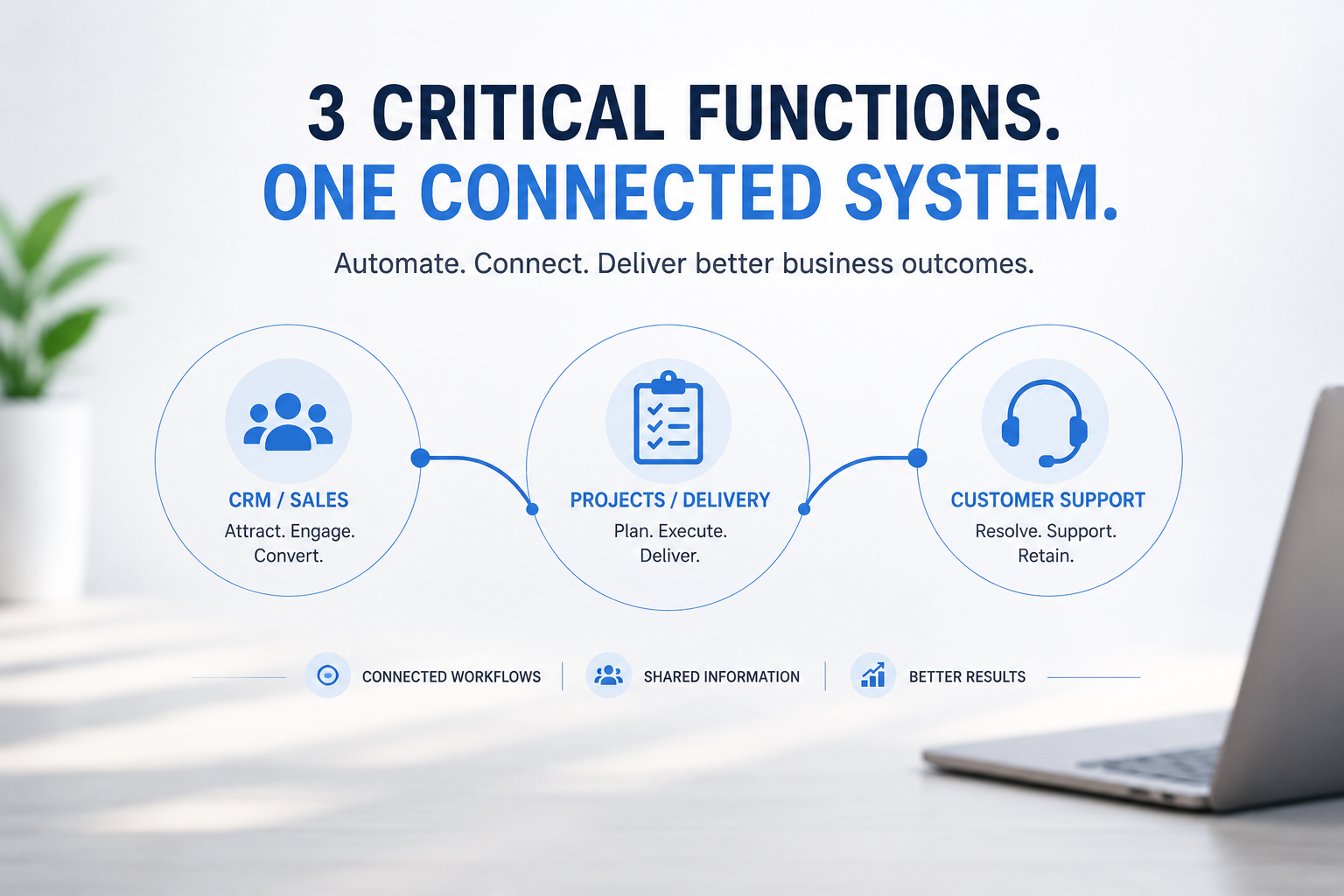
While automation can improve almost every area of a business, three functions benefit particularly from connected and automated workflows:
- Project Management
- Customer Relationship Management (CRM)
- Customer Support
When these operational areas work together within a connected system, businesses are often able to improve efficiency, collaboration, accountability, and scalability across the organization.
Automating Project Management
Managing projects manually across disconnected tools and communication channels can quickly create operational bottlenecks.
Workflow automation helps project teams stay aligned by improving coordination between tasks, timelines, approvals, scheduling, and communication.
Modern project workflow automation can help businesses:
- automate task assignments
- standardize project workflows
- manage dependencies and timelines
- trigger notifications and approvals
- improve visibility into project progress
- reduce scheduling conflicts
- streamline stage-based billing
Connected project workflows also make it easier for teams to adjust schedules dynamically while maintaining visibility across departments and stakeholders.
As projects become more complex, automation helps reduce administrative overhead while improving operational consistency and accountability.
Automating Customer Relationship Management (CRM)
Sales and customer relationship activities involve constant follow-ups, communication tracking, lead management, scheduling, and coordination between teams.
Without structured workflows, important opportunities can easily be delayed, overlooked, or inconsistently managed.
Workflow automation helps businesses streamline CRM processes by:
- automatically routing incoming inquiries
- assigning leads to appropriate team members
- triggering follow-up activities
- organizing customer communications
- tracking customer interactions
- maintaining visibility throughout the sales process
Automated workflows also help reduce repetitive administrative work, allowing sales teams to spend more time building customer relationships instead of manually managing records and processes.
Most importantly, connected CRM workflows help create more consistent customer experiences across the entire sales journey.
Automating Customer Support
Customer support is one of the most operationally sensitive areas of any business.
Slow response times, missed requests, inconsistent communication, and lack of visibility can negatively impact customer trust and retention.
Workflow automation helps customer support teams operate more efficiently by:
- automatically assigning support requests
- routing tickets to appropriate teams
- tracking service activity
- managing support workflows
- monitoring response timelines
- improving visibility into customer issues
Automation also helps leadership teams maintain better oversight into support performance, workloads, bottlenecks, and service responsiveness.
When support processes are connected with customer history, projects, communications, and operational records, teams are often able to provide faster and more informed customer assistance.
Why Connected Automation Matters
The true value of workflow automation is not simply task automation.
Its greatest impact comes from connecting operational activities across the business.
When project management, CRM, customer support, communication, billing, and operational workflows work together within one connected environment, businesses gain:
- improved visibility
- stronger collaboration
- reduced operational friction
- greater accountability
- more consistent processes
- better scalability
Disconnected systems often create disconnected operations.
Connected workflows help businesses operate more cohesively and efficiently as they grow.
Final Thoughts
Many businesses already use software for projects, customer management, support, communication, and operational tasks.
The challenge is often not the lack of tools — it is the lack of operational connection between them.
Workflow automation helps bridge these gaps by creating more connected, organized, and manageable business processes.
As operational complexity increases, businesses that streamline and connect workflows are often better positioned to improve efficiency, support growth, and deliver stronger customer experiences.
BlueCamroo helps businesses connect CRM, projects, customer support, workflows, collaboration, and operational activities within one integrated platform.
If you are looking to reduce operational friction and improve workflow visibility across your business, explore how BlueCamroo can help support your processes from lead to delivery and beyond.
- Solution
- Pricing
- How Your Business Runs
- Developers
- API Documentation

©2026 BlueCamroo Inc. All righs reserved